
Chimney Sweep
Annual flue cleaning, knocked out on the same visit as your other home jobs.
Learn moreWhen a routine sweep can't touch the hardened, tar-like Stage-3 glazed creosote — usually after a chimney fire or years of slow buildup — this is the heavier intervention that actually clears it, using powered rotary chain or flail tools plus PCR (Poultice Creosote Removal), a chemical poultice that softens and lifts the glaze. We often catch the need for it during a regular inspection and can schedule it as part of the same maintenance plan, so you're working with the crew that already knows your system rather than starting over.
Deep cleaning at Texas Service Experts is the procedure for the one deposit a brush genuinely cannot beat: Stage-3 glazed creosote. This is creosote that has condensed and re-baked into a hard, shiny, enamel-like coating fused to the flue wall — concentrated fuel, and the single deposit behind most catastrophic chimney fires. A rod-and-brush sweep glides across it without removing a flake. So we attack it two ways. First, powered rotary tooling: a flexible shaft spun by a drill, carrying chain-knocker or flail heads sized and weighted to your liner, mechanically fractures the glaze off the wall. Second, for glaze too hard or too thick to knock loose safely, PCR — a Poultice Creosote Removal paste — is troweled onto the deposit, left to chemically soften and absorb it, then removed with the hardened creosote lifting away inside it. Together they take a flue back to bare liner that a sweep alone would have left dangerously coated.
Here's how this differs from our chimney sweep service: a sweep is the routine annual cleaning for soft, brushable Stage 1–2 soot and creosote, and on most homes that's the right and only service we'll recommend. Deep cleaning is the opposite end of the spectrum — it exists for the buildup a sweep can't clear, which is why we never sell it as a default. We camera-scope and grade the deposit first; if it's loose or flaky, you get a sweep and we say so. PCR-grade rotary work is held back for confirmed Stage-3 glaze, because running aggressive chain heads on a flue that only needed a brush is both wasteful and a fast way to damage a sound liner. That distinction is the whole point: routine cleaning is a sweep, glaze removal is this.
Method selection is exacting here because the tooling is powerful enough to harm the liner it's cleaning. On clay tile we keep rotary speed controlled and lean on the poultice for the hardest glaze, since over-aggressive chain knocking cracks tile. On a stainless liner we run poly flails only — never steel — so the corrugations get scoured clean without being gouged. The PCR compound is matched to the deposit and given its full dwell time rather than rushed, because a poultice that hasn't fully softened the glaze just smears it. Throughout, dual-stage HEPA negative-air containment captures the heavy, sticky debris this job releases — far more than a routine sweep — so none of it ends up in your home.
Because glazed creosote is the deposit that ignites chimney fires, this is frequently the after-the-fire job: when a Level 2 scope finds heavy Stage-3 glaze, standard guidance is to stop burning until it's gone, and deep cleaning is how it gets gone. We scope before and after, so the cleared flue is documented, not assumed — and if the glaze proves so deeply fused that even rotary tooling and a poultice can't safely fully remove it, we'll tell you honestly that relining is the next step rather than grinding away at tile we could crack. Thick, layered glaze sometimes needs a second poultice pass between visits to fully break down. It's exacting work — confirmed glaze, matched tooling, full poultice dwell, and a verified-clear scope before you ever light another fire — and it's done by the same crew that knows the rest of your system, so the deep clean isn't an isolated event but part of getting the whole fireplace and venting back to safe in one coordinated go.
With our crew, a deep chimney cleaning (pcr) is never guesswork. We scope every job from a graded, photographed inspection first — the NFPA 211 level the evidence calls for — so the work is matched to what your flue and masonry actually need, with the report to prove it. The documented inspection is the record the deep chimney cleaning (pcr) is built on.
Chimney inspectionA deep chimney cleaning (pcr) isn't a matter of opinion — it's held to published national standards. Texas Service builds every job to the named codes below and documents it, so the work is provably right for an inspector, an insurer, or a future buyer. These are the universal standards; your city's permit and inspection requirements are confirmed with the local authority before we pull the job.
Glazed (Stage 3) creosote means the flue is not safe to run. One hot or overfired burn can set that glaze alight, so NFPA guidance says stop burning until the heavy deposit is off. That is why deep cleaning lands as a stop-and-fix finding instead of optional maintenance.
Rotary heads are chosen for the liner in front of them: clay tile gets controlled speed and a poultice so it does not crack, and a stainless liner gets poly flails, never steel, so the corrugations are not gouged. Run the wrong head too hard and a cleaning turns into a relining.
Once a chimney fire has happened, NFPA 211 calls for a Level 2 video inspection of the full flue interior before the system is used again. The scan does two jobs: it confirms the Stage-3 deposit the deep cleaning targets, and it checks that the fire that baked it on did not breach the liner.
Codes cited are the established national standards (NFPA, UL, IRC) that govern this service. The adopted code edition, permit, and inspection requirements vary by city —Texas Service verifies them with your local authority having jurisdiction on every job.
The camera confirms it's Stage-3 glaze, not soft buildup, and rules out a plain sweep.
Dual-stage HEPA negative-air captures the heavy, sticky debris this work throws off.
Drill-driven chain and flail heads, matched to your liner, fracture the glaze off the wall.
PCR paste sits on the worst glaze for a full dwell, then lifts away with the creosote.
A post-clean camera scope confirms bare liner, and we flag relining honestly if glaze won't let go.
We've worked on 1,000+ DFW homes over 10+ years. Every job — small sweep or full rebuild — runs the same way: certified technicians, written quotes, photo reports, warranty in writing.
Powered rotary chain and flail heads strip glaze that a hand brush leaves behind
PCR poultice compound goes after the hardest baked-on Stage-3 deposits
Heads are matched to your liner, poly for stainless and controlled speed on clay
A before-and-after camera scope shows the flue taken back to bare liner
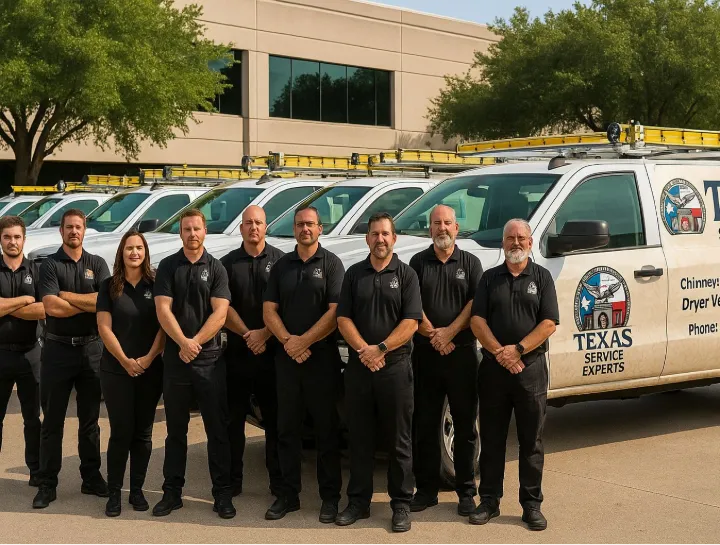
Family-owned, CSIA-certified, NFPA 211–compliant. We're the team you call when you want it done right the first time — no rotating subcontractors, no upsell pressure, no surprises. Same techs, same trucks, same standard.
The NFPA recommends a Level 1 inspection every year, with a sweep once buildup reaches 1/8" of creosote — for a wood fireplace you actually use, that's about once a heating season. The neighborly part: since we're already on the roof, the same crew checks your dryer vent and caps the visit with a quick whole-home safety look, so one appointment covers what would otherwise be three.
Yes — our inspectors hold current CSIA (Chimney Safety Institute of America) certifications, verifiable in the CSIA member directory at csia.org, and we have NFI specialists for fireplace work. The same trained crew handles your chimney, fireplace, dryer-vent and air-duct needs, so you're not juggling four different contractors for one house.
Yes — 24/7 response (subject to crew availability) for active leaks, an animal trapped in the flue, post-fire damage, and storm damage, same-day in most cases. One call reaches one crew that can handle whatever the situation turns out to need, instead of bouncing you between specialists while the water's still coming in.
Always — a written quote before we lift a tool, with photos of what we found, so you see exactly what you're approving. If the same visit turns up something in the dryer vent or ducts, it goes on one itemized quote and one invoice rather than a string of separate trips.
The Whole-Home Care Plan is our annual maintenance plan at $19.99/month ($240/year): a Level 1 inspection and sweep ($248 value), priority scheduling, 10% off all repairs, and emergency-response priority. Because one crew covers chimney, fireplace, dryer-vent and ducts, the plan keeps the whole house on a single schedule instead of a calendar full of separate service calls. Cancel anytime, no contract.
Last reviewed:
Other services in the Cleaning category.
Free written quote. Same-week scheduling. 24/7 emergency response when you need it.
Active leak, animal in flue, post-fire damage, or smoke event? Real humans on the line 7 AM to 12 AM every day — replies in under 2 minutes. Tech dispatch within 2 hours during business hours, subject to crew availability after-hours.
Emergency line