
Chimney Liner
Reline the flue once, correctly — the foundation the rest of the system relies on.
Learn moreThe crown is your chimney's roof, and a hairline crack today is a soaked, spalling stack a few winters from now. We repair, seal, and maintain crowns as a contained half-day job — and because we're already at the top of the chimney, it's the natural moment to refresh the cap or waterproofing in the same visit. Handling the whole crown zone in one trip is exactly how you keep a $300 fix from becoming a $3,000 one.
Bronze or stainless cap with spark arrestor, fully custom-fabricated to your flue.
Drag the model to rotate — see exactly where this component lives in your chimney.
The crown is the chimney's roof, and on most chimneys it was the first thing built wrong. A proper crown is a sloped, reinforced concrete cap that overhangs the brick by two inches or more, drains water away from the masonry, and isolates the flue tile with an expansion joint so thermal movement never cracks it. What countless chimneys actually have is a flat mortar wash troweled flush to the brick — a detail that cracks in its first few freeze-thaw cycles and funnels water straight into the structure. Texas Service Experts repairs and rebuilds crowns to the standard the original mason skipped, because the crown is the single most cost-effective place to stop water before it starts.
The right repair depends entirely on the crown's condition, and we're precise about the line between the two. A structurally sound crown with hairline cracking gets a brush-applied flexible elastomeric CrownCoat-type membrane that bridges the cracks and sheds water while staying elastic through Texas temperature swings — a real seal, not a brittle smear. A crown that's cracked through, spalled, or never more than a thin mortar wash gets recast: we demolish the failed crown and form-and-pour a new sloped concrete crown with the overhang, drip-edge kerf, embedded reinforcement, and flue-tile expansion joint that make it last decades. We tell you honestly which path yours is on, because sealing a crown that should be recast is money spent on a structure that's going to fail anyway.
Because the crown sits at the top of the leak hierarchy, getting it right protects everything underneath — the brick, the flue, the firebox, your ceilings. We detail the bond-break isolation around each flue tile, the drip kerf that throws runoff clear of the brick face, and the slope that drains instead of ponding: the small details that separate a crown that lasts from one that cracks again next winter. On a wide or multi-flue top we embed wire mesh or rebar against cracking, pack backer rod and high-temp sealant into the expansion joint so thermal movement doesn't telegraph into the concrete, and trim protruding flue tile to the 2-to-4-inch projection code wants instead of burying it or leaving it over-long. We handle the smaller crown failures honestly too — a single cracked top course of clay tile, a chimney pot cracked through — fixing the actual defect rather than upselling a recast you don't need.
Get the crown right and you've addressed the leading cause of chimney water damage at its source — which is why we always start at the top. And since the same crew is already up there, it's the sensible moment to seal the cap, check the flashing, and look in on the attic insulation the crown was quietly soaking, so one visit closes the whole water path instead of treating each symptom on its own trip.
With our crew, a chimney crown is never guesswork. We scope every job from a graded, photographed inspection first — the NFPA 211 level the evidence calls for — so the work is matched to what your flue and masonry actually need, with the report to prove it. The documented inspection is the record the chimney crown is built on.
Chimney inspectionA chimney crown isn't a matter of opinion — it's held to published national standards. Texas Service builds every job to the named codes below and documents it, so the work is provably right for an inspector, an insurer, or a future buyer. These are the universal standards; your city's permit and inspection requirements are confirmed with the local authority before we pull the job.
A crown done right hangs past the brick by roughly 2 in or more and carries a drip kerf, so runoff is flung clear of the masonry face instead of running down the brick.
The crown gets a slope, never a flat top, so water drains off rather than ponds. A flat mortar wash troweled flush to the brick is exactly the failure we recast away from.
Around every flue tile the crown carries a bond-break / expansion joint, so thermal movement of the hot flue never cracks the crown concrete.
We trim the clay flue tile to project roughly 2-4 in above the finished crown — proud enough to shed water clear of the crown, but neither cut flush nor left over-long.
Codes cited are the established national standards (NFPA, UL, IRC) that govern this service. The adopted code edition, permit, and inspection requirements vary by city —Texas Service verifies them with your local authority having jurisdiction on every job.
Photo-document the crown — sealable cracks vs. full rebuild scope.
CrownCoat sealing OR full demo + rebuild with proper overhang.
Materials cured per spec, drip edge engineered, watershed angle correct.
1-year workmanship warranty + CrownCoat manufacturer warranty.
We've worked on 1,000+ DFW homes over 10+ years. Every job — small sweep or full rebuild — runs the same way: certified technicians, written quotes, photo reports, warranty in writing.
CrownCoat™ flexible sealant for hairline cracks
Full rebuilds in code-compliant Type S mortar
Proper overhang + drip edge engineered in
Insurance-grade documentation included
Family-owned, CSIA-certified, NFPA 211–compliant. We're the team you call when you want it done right the first time — no rotating subcontractors, no upsell pressure, no surprises. Same techs, same trucks, same standard.
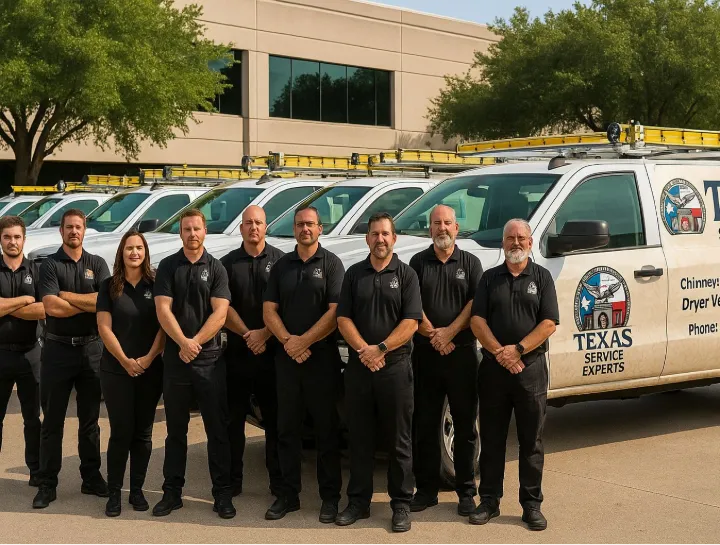
The NFPA recommends a Level 1 inspection every year, with a sweep once buildup reaches 1/8" of creosote — for a wood fireplace you actually use, that's about once a heating season. The neighborly part: since we're already on the roof, the same crew checks your dryer vent and caps the visit with a quick whole-home safety look, so one appointment covers what would otherwise be three.
Yes — our inspectors hold current CSIA (Chimney Safety Institute of America) certifications, verifiable in the CSIA member directory at csia.org, and we have NFI specialists for fireplace work. The same trained crew handles your chimney, fireplace, dryer-vent and air-duct needs, so you're not juggling four different contractors for one house.
Yes — 24/7 response (subject to crew availability) for active leaks, an animal trapped in the flue, post-fire damage, and storm damage, same-day in most cases. One call reaches one crew that can handle whatever the situation turns out to need, instead of bouncing you between specialists while the water's still coming in.
Always — a written quote before we lift a tool, with photos of what we found, so you see exactly what you're approving. If the same visit turns up something in the dryer vent or ducts, it goes on one itemized quote and one invoice rather than a string of separate trips.
The Whole-Home Care Plan is our annual maintenance plan at $19.99/month ($240/year): a Level 1 inspection and sweep ($248 value), priority scheduling, 10% off all repairs, and emergency-response priority. Because one crew covers chimney, fireplace, dryer-vent and ducts, the plan keeps the whole house on a single schedule instead of a calendar full of separate service calls. Cancel anytime, no contract.
Last reviewed:
Other services in the Repair category.
Free written quote. Same-week scheduling. 24/7 emergency response when you need it.
Active leak, animal in flue, post-fire damage, or smoke event? Real humans on the line 7 AM to 12 AM every day — replies in under 2 minutes. Tech dispatch within 2 hours during business hours, subject to crew availability after-hours.
Emergency line