
Chimney Framing Rebuild
Full code-compliant chase rebuild — framing, siding, and cover by one crew.
Learn moreTexas weather swings hard, and water that soaks into your masonry freezes, expands, and quietly cracks it apart. We apply a breathable, vapor-permeable treatment across the whole stack that sheds rain while still letting trapped moisture escape — and we check the crown and flashing first, so it's done as one complete water-defense pass rather than sealing over a leak you'll have to reopen later. While the crew is set up at the top, it's the efficient time to settle every weather-entry point at once.
Layered metal sealing the chimney-roof junction.
Drag the model to rotate — see exactly where this component lives in your chimney.
Waterproofing a chimney is a whole-stack program, not a spot treatment. A masonry chimney is the single most water-exposed assembly on the house — four faces standing above the roofline catching wind-driven rain, a crown taking the full sky, and flashing at the only seam where the stack meets the roof. Texas Service Experts treats the entire stack as one system: we flood-coat every brick face and mortar joint from the crown line down with a vapor-permeable siloxane/silane repellent so the whole chimney sheds liquid water while the masonry still breathes out the vapor already inside it. How this differs from our waterproofing-bricks service: that page is brick-face-specific — selecting a product for the condition of spalling or efflorescing brick and veneer and repairing those faces before sealing — whereas this is the comprehensive program that wraps the stack as a unit and checks the crown and flashing as part of the same visit.
The chemistry isn't optional, and it's the same principle that makes treating the whole stack worthwhile: only a breathable, vapor-permeable repellent belongs on a chimney. Film-forming sealers — paint, glossy acrylics, hardware-store "waterproofers" — trap moisture in the masonry, and trapped water in a freeze-thaw climate spalls brick from the inside out. We use a ChimneySaver-class siloxane that beads surface water while every treated face keeps drying. Because the goal is the whole envelope rather than one elevation, we flood every side to refusal in an even, saturating coat — a uniformly treated chimney sheds water consistently, while a partial seal just shoves the water onto whatever face got skipped.
Sealing the faces is only half of a real whole-stack program, because the top of the stack is where most water actually gets in. The crown, the cap, and the step-and-counter flashing are the chimney's front-line defenses, and a flawless repellent on the brick does nothing if water is pouring through a cracked crown or a lifted flashing leg above it. So the same visit includes a crown-and-flashing check — we look for crown cracks, a failed cap, and flashing that's pulled away — because sealing the faces while leaving an open crown just locks the problem inside the stack. That top-down scope, crown and flashing verified before the masonry envelope is sealed, is what separates a true waterproofing program from a brick-face touch-up.
Sequence and honesty govern the work. Repellent is the last step over a sound, dry stack, never a substitute for repair, so if the chimney needs tuckpointing, a crown rebuild, or new flashing, we do that first and seal the whole assembly after — waterproofing a deteriorated stack is just money spent sealing the damage in. Done right on a prepared chimney, a whole-stack breathable treatment is one of the highest-return preventive jobs we offer, protecting the entire masonry envelope against the most destructive force a chimney faces. Because the crew that seals the stack is the same one that repaired it — and the same one that maintains your vents and insulation — the whole water story gets handled by people who already know your house, in as few trips as the work allows.
With our crew, a chimney waterproofing is never guesswork. We scope every job from a graded, photographed inspection first — the NFPA 211 level the evidence calls for — so the work is matched to what your flue and masonry actually need, with the report to prove it. The documented inspection is the record the chimney waterproofing is built on.
Chimney inspectionA chimney waterproofing isn't a matter of opinion — it's held to published national standards. Texas Service builds every job to the named codes below and documents it, so the work is provably right for an inspector, an insurer, or a future buyer. These are the universal standards; your city's permit and inspection requirements are confirmed with the local authority before we pull the job.
Masonry chimneys take a vapor-permeable water repellent, meaning siloxane or silane, and never a film-forming sealer. Brick has to breathe: the repellent lets the whole stack shed liquid water while vapor still escapes, where a film-former locks moisture inside and speeds up freeze-thaw spalling.
Before any face gets treated, our crew checks the crown and seals or repairs it, because the crown is the stack's first defense against water. Waterproof the faces over a cracked crown and you have sealed the water in rather than out.
On the same visit we verify the step-and-counter flashing where the stack meets the roof, because water entering at a lifted flashing leg defeats every treated masonry face below it.
Codes cited are the established national standards (NFPA, UL, IRC) that govern this service. The adopted code edition, permit, and inspection requirements vary by city —Texas Service verifies them with your local authority having jurisdiction on every job.
We check the crown, cap, and flashing first, since that's where water gets in above the brick.
Every face gets cleaned, and we handle any joint, crown, or flashing repair before the coat goes on.
We saturate each face and joint with a breathable repellent, working it to refusal.
Confirm full-stack coverage and record the treated assembly.
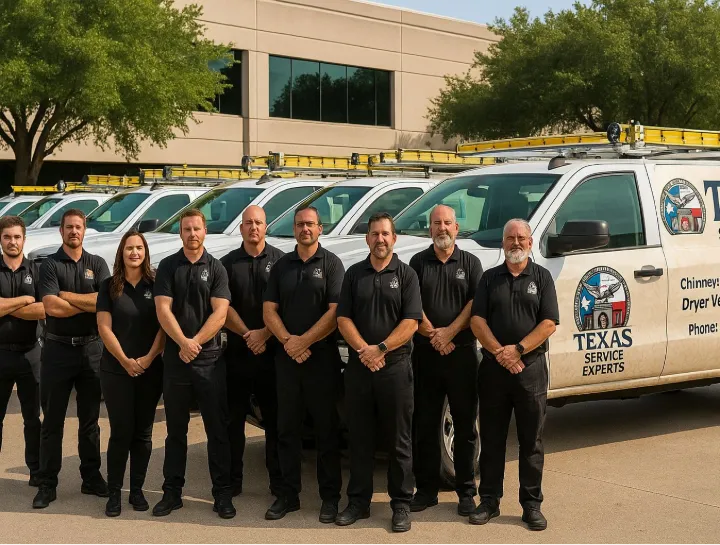
We've worked on 1,000+ DFW homes over 10+ years. Every job — small sweep or full rebuild — runs the same way: certified technicians, written quotes, photo reports, warranty in writing.
Every face and joint of the stack gets coated, not just the one elevation you can see
Crown, cap, and flashing checked in the same visit
Vapor-permeable repellent only — the stack still breathes
Any repairs come first, before we seal, so nothing gets locked in behind the coat
Family-owned, CSIA-certified, NFPA 211–compliant. We're the team you call when you want it done right the first time — no rotating subcontractors, no upsell pressure, no surprises. Same techs, same trucks, same standard.
The NFPA recommends a Level 1 inspection every year, with a sweep once buildup reaches 1/8" of creosote — for a wood fireplace you actually use, that's about once a heating season. The neighborly part: since we're already on the roof, the same crew checks your dryer vent and caps the visit with a quick whole-home safety look, so one appointment covers what would otherwise be three.
Yes — our inspectors hold current CSIA (Chimney Safety Institute of America) certifications, verifiable in the CSIA member directory at csia.org, and we have NFI specialists for fireplace work. The same trained crew handles your chimney, fireplace, dryer-vent and air-duct needs, so you're not juggling four different contractors for one house.
Yes — 24/7 response (subject to crew availability) for active leaks, an animal trapped in the flue, post-fire damage, and storm damage, same-day in most cases. One call reaches one crew that can handle whatever the situation turns out to need, instead of bouncing you between specialists while the water's still coming in.
Always — a written quote before we lift a tool, with photos of what we found, so you see exactly what you're approving. If the same visit turns up something in the dryer vent or ducts, it goes on one itemized quote and one invoice rather than a string of separate trips.
The Whole-Home Care Plan is our annual maintenance plan at $19.99/month ($240/year): a Level 1 inspection and sweep ($248 value), priority scheduling, 10% off all repairs, and emergency-response priority. Because one crew covers chimney, fireplace, dryer-vent and ducts, the plan keeps the whole house on a single schedule instead of a calendar full of separate service calls. Cancel anytime, no contract.
Last reviewed:
Other services in the Construction category.
Free written quote. Same-week scheduling. 24/7 emergency response when you need it.
Active leak, animal in flue, post-fire damage, or smoke event? Real humans on the line 7 AM to 12 AM every day — replies in under 2 minutes. Tech dispatch within 2 hours during business hours, subject to crew availability after-hours.
Emergency line