
Chimney Cap
The small cap that keeps rain, animals, and embers out — fitted while we're up there.
Learn moreA spark arrestor is the small screen that keeps your own fire from landing on the roof or a neighbor's — code-required in wildfire zones, with 3/8"–1/2" mesh openings sized per NFPA 211. We install or replace it right on the cap, and since it's a one-hour job at the top of the chimney, it makes sense to pair it with a new stainless cap or a sweep we're already doing. No reason to book a separate trip for a screen.
A spark arrestor does one fire-safety job: it catches the live embers a wood fire sends up the flue before they can land burning on your roof or in dry brush. Hot, lightweight embers ride the draft all the way to the top, and over a combustible roof or in a wildfire-prone area an escaping ember is a roof-fire or wildland-fire ignition source. Texas Service Experts installs and retrofits arrestor screens sized and built to contain those embers reliably. How this differs from our chimney-cap service: a cap is the weather-and-animal lid that keeps rain and wildlife out; a spark arrestor is the ember screen that keeps fire in. The two are often combined in one fitting, but their jobs run in opposite directions — the cap protects the flue from the outside, the arrestor protects the outside from the flue.
The mesh sizing is the heart of this job, and it's a genuine balancing act the cap never has to make. The screen openings have to be small enough to stop an ember — no larger than 1/2 inch under NFPA 211 — yet open enough not to clog with soot and choke the draft, which is why code also sets a 3/8-inch minimum. Too fine a screen soots shut and the appliance smokes back into the room; too coarse and embers sail right through. We size the mesh to the code range and to the way the appliance actually burns, and we build the screen in stainless so it doesn't rust thin and fail open — a corroded arrestor is just a screen with holes in it, no longer arresting anything.
Much of this is a retrofit, not a new top. Plenty of chimneys already carry a perfectly good weather cap but no ember screen, or an old arrestor that's rusted through, torn, or sooted solid — so we add or replace the mesh on the existing fitting rather than reinventing the whole top. Where a chimney has no top hardware at all, we install an arrestor integrated into a cap so you get ember containment and weather protection in one trip; but the arrestor function — the code-sized screen — is what this service is specifically about, and we'll fit one to a cap you already own. How it differs from the cap page: there the question is sealing out rain and animals, here it's screening in sparks to a verified mesh size.
Where this service earns its keep is the wildland-urban interface and any home near trees or dry brush — the places where a single escaped ember is a real wildfire risk and a local burn code or insurer often makes a compliant arrestor mandatory. We confirm the local requirement, which can be stricter than the NFPA baseline, and document the installed mesh size so the screen is provably code-compliant for an inspection or insurance file. And since the same crew is already up top for the sweep or the cap, adding or replacing the arrestor screen is a same-visit job, not another appointment: a confirmed mesh size, a stainless screen that won't rust open, and a fitting that stays put — so the embers your fire throws stay inside the flue where they belong.
With our crew, a spark arrestor installation is never guesswork. We scope every job from a graded, photographed inspection first — the NFPA 211 level the evidence calls for — so the work is matched to what your flue and masonry actually need, with the report to prove it. The documented inspection is the record the spark arrestor installation is built on.
Chimney inspectionA spark arrestor installation isn't a matter of opinion — it's held to published national standards. Texas Service builds every job to the named codes below and documents it, so the work is provably right for an inspector, an insurer, or a future buyer. These are the universal standards; your city's permit and inspection requirements are confirmed with the local authority before we pull the job.
An arrestor screen's openings can be no larger than 1/2 inch, so escaping embers get caught, while NFPA 211 also holds them to a 3/8-inch minimum so the mesh does not soot shut and choke the draft. That engineered size window separates a true arrestor from a plain cap collar: it stops sparks and still vents.
Where a chimney serves a solid-fuel appliance and terminates over a combustible roof, a spark arrestor is required, because that is exactly where an escaping ember can ignite the roofing. Think of it as fire containment, not weather protection.
In a wildland-urban interface or a designated fire-hazard zone, local codes often demand an arrestor standard tighter than the NFPA baseline. Whichever mesh and material requirement is stricter governs the job, and our crew installs and documents to that standard.
Stainless is the only screen material worth installing here, since a mesh that rusts thin fails open. Once rust eats gaps into it, embers pass straight through and nothing gets arrested, no matter how good the cap around it still looks.
Codes cited are the established national standards (NFPA, UL, IRC) that govern this service. The adopted code edition, permit, and inspection requirements vary by city —Texas Service verifies them with your local authority having jurisdiction on every job.
We look at whether a cap or screen is already up there and what your local wildfire-code mesh spec calls for.
We pick stainless mesh in the 3/8"–1/2" range, which holds back embers while still letting the flue draft freely.
We either fit the screen onto your existing cap or set an integrated arrestor-cap, mounted solidly so it stays put.
We confirm the installed mesh size and take photos of it for your code file or insurance record.
We've worked on 1,000+ DFW homes over 10+ years. Every job — small sweep or full rebuild — runs the same way: certified technicians, written quotes, photo reports, warranty in writing.
Mesh cut to the NFPA 211 ember-containment range, tight enough to catch sparks yet open enough to keep the draft moving
We retrofit onto the cap you already have, adding the ember screen rather than replacing the whole top
Stainless screen that won't rust thin and fail open above a combustible roof
The installed mesh size documented for wildfire-code and insurance files
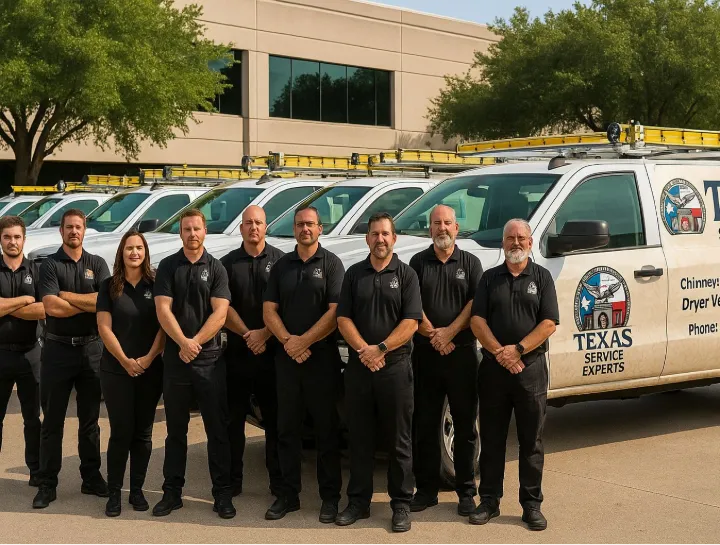
Family-owned, CSIA-certified, NFPA 211–compliant. We're the team you call when you want it done right the first time — no rotating subcontractors, no upsell pressure, no surprises. Same techs, same trucks, same standard.
The NFPA recommends a Level 1 inspection every year, with a sweep once buildup reaches 1/8" of creosote — for a wood fireplace you actually use, that's about once a heating season. The neighborly part: since we're already on the roof, the same crew checks your dryer vent and caps the visit with a quick whole-home safety look, so one appointment covers what would otherwise be three.
Yes — our inspectors hold current CSIA (Chimney Safety Institute of America) certifications, verifiable in the CSIA member directory at csia.org, and we have NFI specialists for fireplace work. The same trained crew handles your chimney, fireplace, dryer-vent and air-duct needs, so you're not juggling four different contractors for one house.
Yes — 24/7 response (subject to crew availability) for active leaks, an animal trapped in the flue, post-fire damage, and storm damage, same-day in most cases. One call reaches one crew that can handle whatever the situation turns out to need, instead of bouncing you between specialists while the water's still coming in.
Always — a written quote before we lift a tool, with photos of what we found, so you see exactly what you're approving. If the same visit turns up something in the dryer vent or ducts, it goes on one itemized quote and one invoice rather than a string of separate trips.
The Whole-Home Care Plan is our annual maintenance plan at $19.99/month ($240/year): a Level 1 inspection and sweep ($248 value), priority scheduling, 10% off all repairs, and emergency-response priority. Because one crew covers chimney, fireplace, dryer-vent and ducts, the plan keeps the whole house on a single schedule instead of a calendar full of separate service calls. Cancel anytime, no contract.
Last reviewed:
Other services in the Installation category.
Free written quote. Same-week scheduling. 24/7 emergency response when you need it.
Active leak, animal in flue, post-fire damage, or smoke event? Real humans on the line 7 AM to 12 AM every day — replies in under 2 minutes. Tech dispatch within 2 hours during business hours, subject to crew availability after-hours.
Emergency line