
Above-Roofline Chimney Removal
Take the dead stack down to the deck and close the roof like it was never there.
Learn moreThat brick chimney breast jutting into the room is prime square footage you're not using, and one of the easiest removals to do dangerously. We assess what the breast carries, install engineered steel gallows brackets to hold the retained masonry above, then frame and finish the opening flush so the wall reads as original — the load is never unsupported for a moment. Structural support, framing, and finish all come from one crew, so you get the room back as a turnkey project on a single schedule.
The chimney breast — that masonry bulkhead projecting into a bedroom, living room, or kitchen — is prime square footage trapped behind brick. Removing it to gain a flat, usable wall is one of the highest-value interior projects a homeowner can do, and one of the easiest to do dangerously. Texas Service Experts removes breasts the careful way: load assessed, upper masonry supported, the opening framed and finished flush so the room reads as if it was always one clean plane — and because one crew handles the structural work, the framing, and the finish, you're not juggling a mason, an engineer, and a drywall contractor for a single wall.
The hazard in breast removal is invisible. The breast you want gone often carries the chimney breast above it on the next floor, plus the stack in the attic. Cut out the lower section without carrying that load and you've set up a slow structural failure — cracked plaster upstairs at best, a dropped stack at worst. Our leads determine exactly what the breast supports before any masonry moves and design the support to match.
Where an upper breast or stack has to stay, we install steel gallows brackets — an engineered frame that transfers the retained masonry's weight into the surrounding structural walls — so everything above is carried safely and permanently. Where the full vertical run is coming out, we sequence that instead. Either way, the load never goes unsupported for a moment, and the homeowner never sees a crack appear three months later.
Once the breast is out, the finish is where the one-crew approach pays off: we frame the cavity, insulate it to match the wall, hang and finish drywall, and bring the new surface flush with the existing plane so there's no telltale bump or seam. Outlets and switches are relocated cleanly if the old brick hosted them. The job is contained — floors and adjacent rooms protected, dust controlled, rubble hauled — and you receive documentation of the support detail and the framed infill before it's closed up, all from the same accountable team.
With our crew, a chimney-breast removal & structural infill is never guesswork. We scope every job from a graded, photographed inspection first — the NFPA 211 level the evidence calls for — so the work is matched to what your flue and masonry actually need, with the report to prove it. The documented inspection is the record the chimney-breast removal & structural infill is built on.
Chimney inspectionWe work out what the breast supports, whether that's a breast above or the attic stack, then design the support to match.
We fit steel gallows brackets to carry the retained masonry, or sequence a full vertical removal instead.
The breast masonry comes out under dust containment, with rubble hauled and brick salvaged if you ask.
We frame, insulate, drywall, and bring the surface flush, then coordinate the paint and trim hand-off.
We've worked on 1,000+ DFW homes over 10+ years. Every job — small sweep or full rebuild — runs the same way: certified technicians, written quotes, photo reports, warranty in writing.
We assess the load first, working out what the breast carries before any masonry is touched.
Engineered steel gallows brackets take the weight of the retained upper masonry for good.
The wall is finished dead-flush with the existing plane, leaving no proud patch or seam.
The job is permitted and contained, with the support detail documented before we close it up.
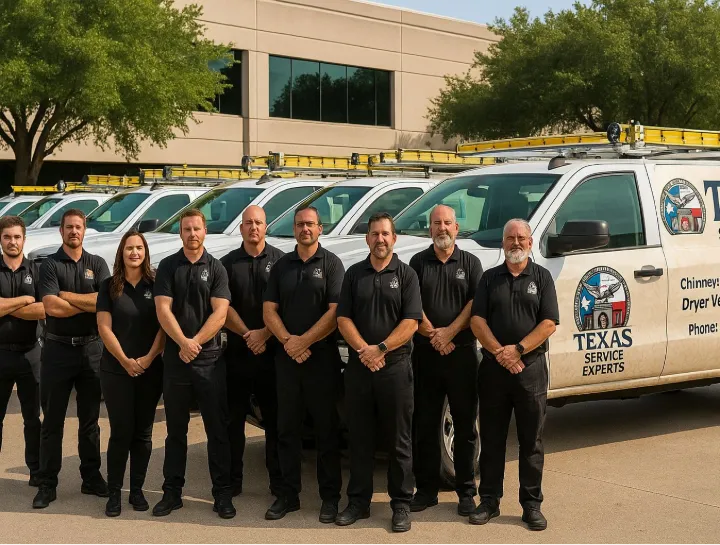
Family-owned, CSIA-certified, NFPA 211–compliant. We're the team you call when you want it done right the first time — no rotating subcontractors, no upsell pressure, no surprises. Same techs, same trucks, same standard.
The NFPA recommends a Level 1 inspection every year, with a sweep once buildup reaches 1/8" of creosote — for a wood fireplace you actually use, that's about once a heating season. The neighborly part: since we're already on the roof, the same crew checks your dryer vent and caps the visit with a quick whole-home safety look, so one appointment covers what would otherwise be three.
Yes — our inspectors hold current CSIA (Chimney Safety Institute of America) certifications, verifiable in the CSIA member directory at csia.org, and we have NFI specialists for fireplace work. The same trained crew handles your chimney, fireplace, dryer-vent and air-duct needs, so you're not juggling four different contractors for one house.
Yes — 24/7 response (subject to crew availability) for active leaks, an animal trapped in the flue, post-fire damage, and storm damage, same-day in most cases. One call reaches one crew that can handle whatever the situation turns out to need, instead of bouncing you between specialists while the water's still coming in.
Always — a written quote before we lift a tool, with photos of what we found, so you see exactly what you're approving. If the same visit turns up something in the dryer vent or ducts, it goes on one itemized quote and one invoice rather than a string of separate trips.
The Whole-Home Care Plan is our annual maintenance plan at $19.99/month ($240/year): a Level 1 inspection and sweep ($248 value), priority scheduling, 10% off all repairs, and emergency-response priority. Because one crew covers chimney, fireplace, dryer-vent and ducts, the plan keeps the whole house on a single schedule instead of a calendar full of separate service calls. Cancel anytime, no contract.
Last reviewed:
Other services in the Removal & Decommission category.
Free written quote. Same-week scheduling. 24/7 emergency response when you need it.
Active leak, animal in flue, post-fire damage, or smoke event? Real humans on the line 7 AM to 12 AM every day — replies in under 2 minutes. Tech dispatch within 2 hours during business hours, subject to crew availability after-hours.
Emergency line