
Above-Roofline Chimney Removal
Take the dead stack down to the deck and close the roof like it was never there.
Learn moreNot every unwanted fireplace needs to come down — often the smarter, lower-cost move is to retire it in place and keep the mantel as a focal point. We seal the flue top and bottom with a breathable vented cap so the masonry doesn't trap moisture, cap any gas line at the branch and pressure-test it, and fill the ash pit — a genuinely inert, dry, sealed system. The flue work, gas capping, and documentation are all handled by one crew in a single day, so the safety and energy liabilities are gone for good without a demolition project.
Not every unwanted fireplace needs to come down. Often the smarter solution is to decommission it in place — permanently seal a disused flue or retire a gas appliance — so the masonry stays as a mantel and focal point while the liabilities go away. Texas Service Experts does abandon-in-place work the way it should be done: sealed top and bottom against moisture, gas lines capped and pressure-verified, and the whole retirement documented so it holds up to an inspector — and since one crew handles the cap, the gas, and the ash pit, the fireplace is fully retired in a single visit.
Leave a flue open but unused and you've created a quiet drain. Stack effect pulls conditioned air out through it, rain and condensation seep into masonry that no longer dries from a fire, and birds and squirrels find an easy way in. Stuffing it or slapping a cap on top is the cheap version — it either traps moisture or leaves a path for water. We seal the top with a vented cap that keeps weather and animals out while the masonry still breathes, and seal the bottom at the firebox or throat so air can't move through. That breathe-but-don't-leak balance is the craft detail amateurs miss.
For a gas fireplace decommission, the discipline matters even more. We disconnect the appliance, remove it if requested, and permanently cap the gas supply at the branch — then pressure/leak-test the capped line to confirm a tight, code-compliant seal. An untested cap-off is the single most common corner cut in this work, and it's exactly the kind of latent gas liability we refuse to leave in a customer's wall. The test result goes in your documentation package.
Decommission-in-place also means dealing with the parts that keep causing problems if ignored. Where there's an ash dump and pit, we fill and seal them; where an abandoned flue could still sweat, we back-fill or insulate the cavity. The objective is a system that's genuinely retired — inert, dry, and sealed — not merely switched off. The fireplace stays as a focal point if you want it; the safety and energy drain are gone for good.
With our crew, a flue capping & fireplace decommission is never guesswork. We scope every job from a graded, photographed inspection first — the NFPA 211 level the evidence calls for — so the work is matched to what your flue and masonry actually need, with the report to prove it. The documented inspection is the record the flue capping & fireplace decommission is built on.
Chimney inspectionA vented cap goes on top and the firebox and throat get sealed at the bottom, keeping weather out while the masonry breathes.
We disconnect the appliance and permanently cap the supply at the branch.
Pressure-test the capped gas line so the seal holds tight and meets code before we close up.
Pack and seal the ash pit, then hand you a packet covering the cap detail, the gas-test result, and job photos.
We've worked on 1,000+ DFW homes over 10+ years. Every job — small sweep or full rebuild — runs the same way: certified technicians, written quotes, photo reports, warranty in writing.
The flue is sealed top and bottom with a vented cap, keeping weather out while the masonry still breathes.
The gas supply is capped at the branch and pressure/leak-tested, with the result documented.
We fill and seal the ash pit and cleanout so the whole system is genuinely inert.
You keep the fireplace as a mantel or focal point, but with the liabilities taken out of it.
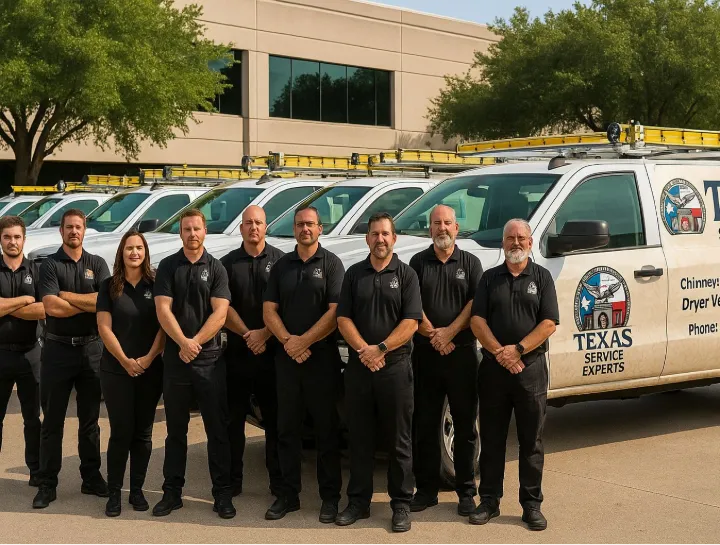
Family-owned, CSIA-certified, NFPA 211–compliant. We're the team you call when you want it done right the first time — no rotating subcontractors, no upsell pressure, no surprises. Same techs, same trucks, same standard.
The NFPA recommends a Level 1 inspection every year, with a sweep once buildup reaches 1/8" of creosote — for a wood fireplace you actually use, that's about once a heating season. The neighborly part: since we're already on the roof, the same crew checks your dryer vent and caps the visit with a quick whole-home safety look, so one appointment covers what would otherwise be three.
Yes — our inspectors hold current CSIA (Chimney Safety Institute of America) certifications, verifiable in the CSIA member directory at csia.org, and we have NFI specialists for fireplace work. The same trained crew handles your chimney, fireplace, dryer-vent and air-duct needs, so you're not juggling four different contractors for one house.
Yes — 24/7 response (subject to crew availability) for active leaks, an animal trapped in the flue, post-fire damage, and storm damage, same-day in most cases. One call reaches one crew that can handle whatever the situation turns out to need, instead of bouncing you between specialists while the water's still coming in.
Always — a written quote before we lift a tool, with photos of what we found, so you see exactly what you're approving. If the same visit turns up something in the dryer vent or ducts, it goes on one itemized quote and one invoice rather than a string of separate trips.
The Whole-Home Care Plan is our annual maintenance plan at $19.99/month ($240/year): a Level 1 inspection and sweep ($248 value), priority scheduling, 10% off all repairs, and emergency-response priority. Because one crew covers chimney, fireplace, dryer-vent and ducts, the plan keeps the whole house on a single schedule instead of a calendar full of separate service calls. Cancel anytime, no contract.
Last reviewed:
Other services in the Removal & Decommission category.
Free written quote. Same-week scheduling. 24/7 emergency response when you need it.
Active leak, animal in flue, post-fire damage, or smoke event? Real humans on the line 7 AM to 12 AM every day — replies in under 2 minutes. Tech dispatch within 2 hours during business hours, subject to crew availability after-hours.
Emergency line